
Showing posts with label poultry. Show all posts
Showing posts with label poultry. Show all posts
Sunday, August 18, 2013
Breast Milk for Chicks?
Well not exactly, but yolk is what the chicks eat inside the egg as they are developing embryos. So I was thinking wouldn't cooked egg yolk fed to chicks now help give a natural boost to their immune system as well as be a completely organic unaltered nutritious snack for them? Infant mammals thrive on breast milk and it is essential to developing babies health and immune systems. After doing a little research, it seems that I am not the only person to think along these lines. So after cleaning up some eggs for the fridge, I decided to boil up a treat for the chicks. I hard boiled a dozen eggs and took out all the yolks [the pigs and chickens enjoyed the shells and whites]. I then crumbled up about half a yolk on a plate and set it into the brooders. The blue laced red wyandottes, welsummer, silver laced wyandottes, and speckled sussex went crazy! They immediately devoured it all, chasing each other around in a game of 'chicken football' as I like to call it. The blue silkies and guineas were a bit slower to respond, but seem to be enjoying them as well! Once the plates were empty, I removed them and watched the little ones chirping away happily. I will take notes to see if there are any issues with it, but I think I just found a great snack that will help out the wee ones.

Blue Laced Red Wyandottes and Blue Silkies Day 5 on the Homestead
Just a few pics of the the chicks on their 5th day here. They have been doing extremely well! We did lose one of the Silkies, not sure what happened. My wife found it one morning when we woke up. They all seem healthy and happy though. Here are the pics:



Keets and Chicks! Order 2
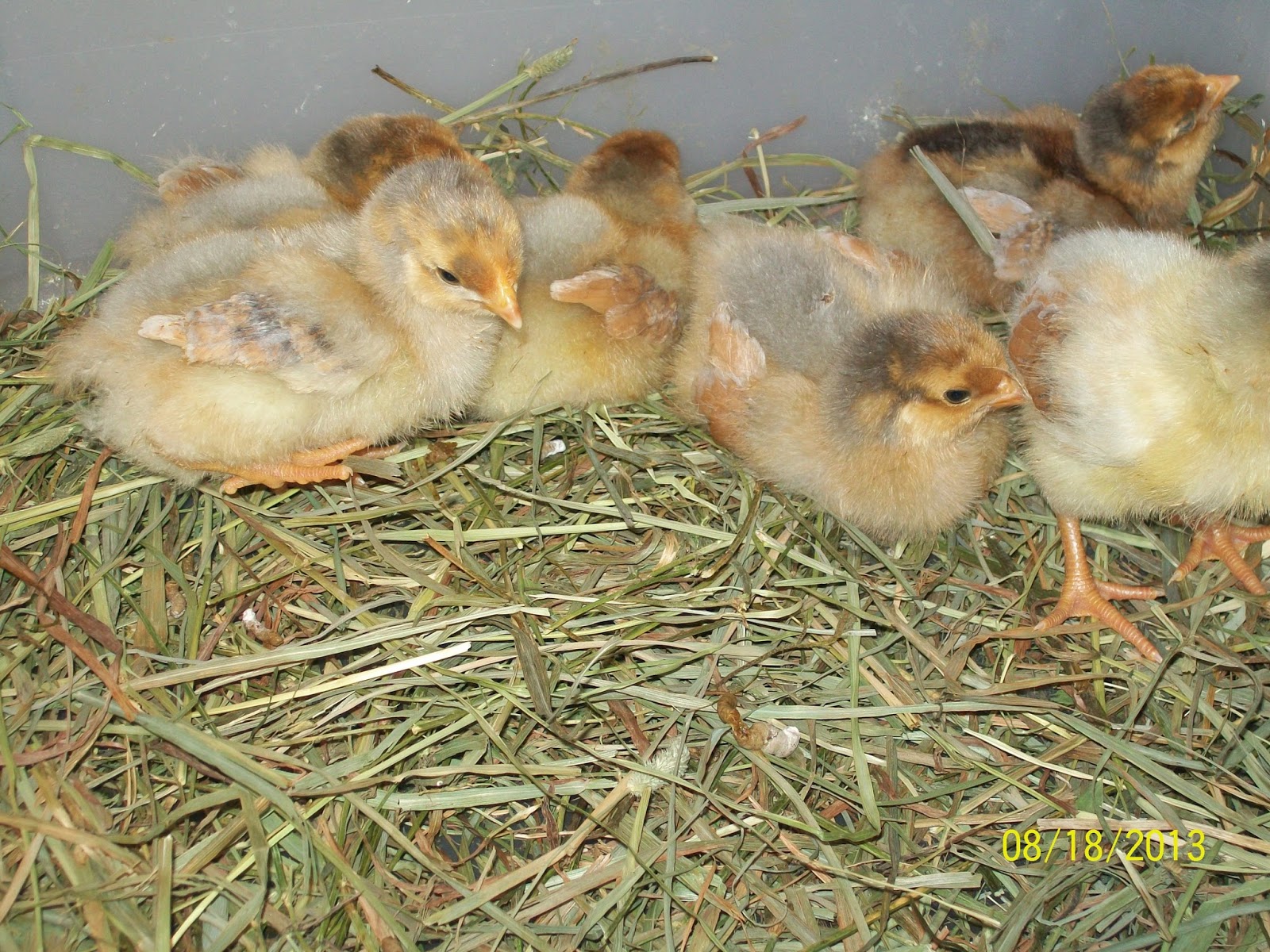
Our keets and chicks arrived on Friday mornings. This order came from Cackle Hatchery. My wife had to go retrieve them from the post office in the morning. The keets were a running bustle of tiny bodies! This is our first time with Guineas so we are very excited to enter into their little world. The hatchery was running a special on straight run hatcheries choice keets so we signed up and are quite impressed with the variety that has arrived. There are several of each including White Africans, Pearl Grays, Lavenders, and Royal Purples. I believe they will be quite a beautiful flock! [And my wife loves the color purple!] They are definitely a joy to watch, though they seem so delicate compared to the chicks. We did lose two so far for no explainable reason, but there was two extra. From what I have read this is not abnormal, due to their size and excitability. Here are some pics:


Our other chicks also arrived. They are Welsummer, Speckled Sussex, and Silver Laced Wyandottes. Unfortunately they were unable to add our Black Australorpes with this order so they will be arrived at a later time. They all are very healthy and active as well. I believe they are a bit older than 'day-old' because they seem larger and are showing feathers just like our chicks that arrived earlier in the week. Most likely they had to wait to be shipped to join the keets is what I am thinking. They are very beautiful chicks though, with very impressive colorings. Here they are:


Tuesday, August 13, 2013
Poultry Order #1 Arrived
Our first order of chicks arrived today. These chicks were ordered from Murray McMurray Hatchery and arrived very quickly. We were notified that they shipped at 17:00 yesterday, and this morning they were at our post office. The Postman made a special trip to deliver them to the house. This order was our Blue Laced Red Wyandottes and Blue Silkie Bantams. When my wife opened the box one of the bantams had expired. The Hatchery included an extra of each though, so we are still up one. The little guy was buried in a peaceful spot in the forest. Everyone else seems to be doing extremely well and are very active. All have taken to the water and are pecking at feed in their new warm homes. We are keeping the two in separate containers, as they will serve different purposes and not be part of the same flock. Included with our order was the option to have a free rare exotic chick included with the order. Of course we opted to do so. It will be a quite interesting experience attempting to identify the wee one! We have already made a guess, but will have to wait and see what he/she grows into as no one honestly knows which rare chick is included.
Blue Laced Red Wyandottes:
Blue Laced Red Wyandottes:


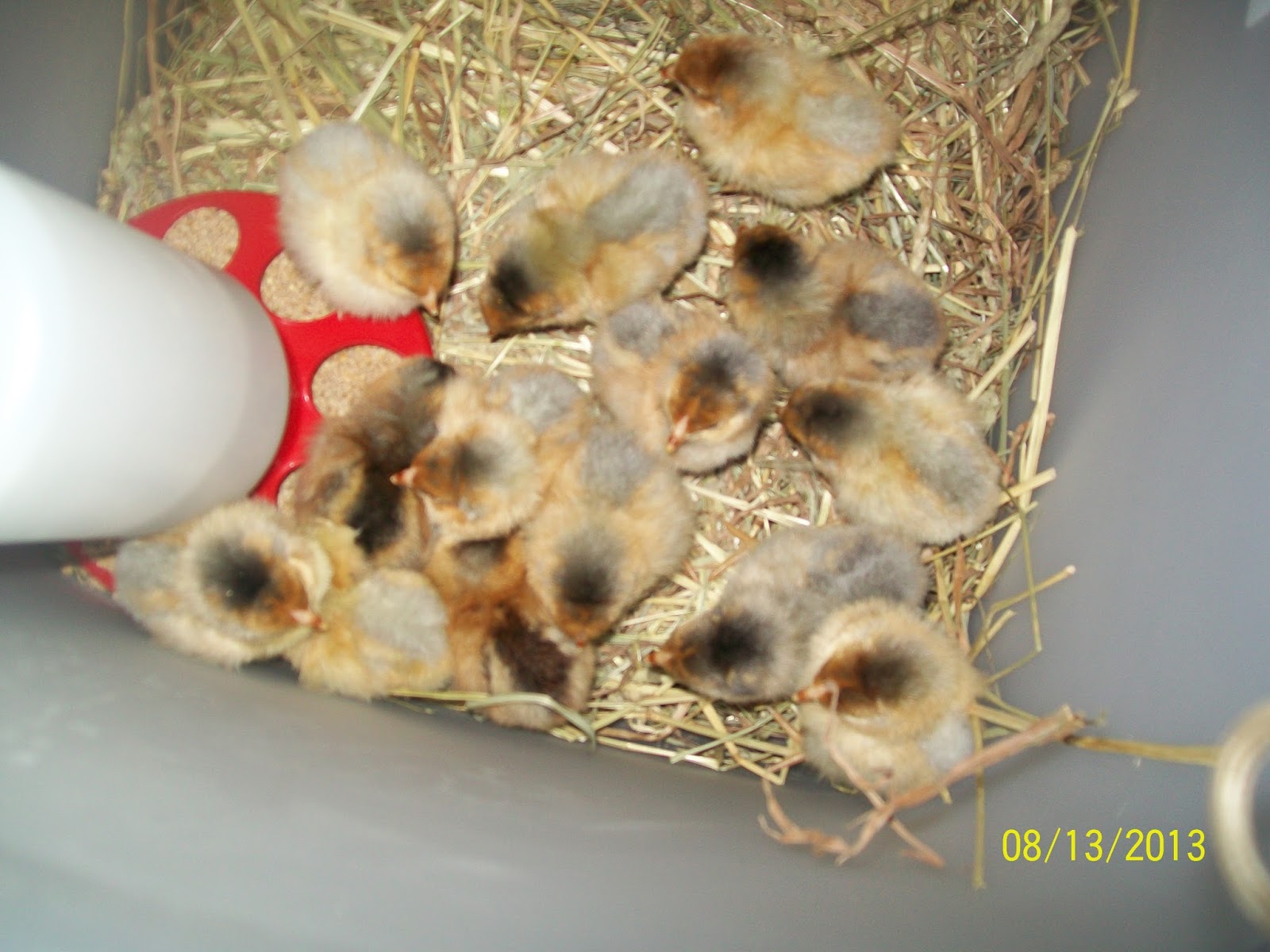

Blue Silkie Bantams
 |
| The Rare Exotic Chick is the one on the right with the Gold face mask. |


Saturday, August 3, 2013
Poultry decisions!
Ever since we have started our flock, we have added more chicks every spring so as to keep revitalizing the flock and to keep a steady supply of eggs available. This year we were not financially able to follow our normal plan, and though our little one was sad as we usually always get chicks near her birthday, we explained the situation to her and decided we would have to wait. We had hoped that having four hens go broody [3 Black Australorpes and 1 Barred Rock] would have remedied that situation, but for some reason they just can't seem to hatch any eggs. I am sure there are several reasons for that, but we have not solved the problem yet. We tried isolating the hens as they went broody, but they would get so upset in isolation that they would break all their eggs in their attempts to remove themselves from the isolation pen. We tried to isolate them in the hen house where they originally went broody, but they would spend time escaping and stop brooding. So we decided to let them go naturally and see what happened. Well the answer was nothing...they have brooded eggs for three months now and not hatched a single egg. I believe that part of it is human error and part of it is that the other hens will not leave them alone. They literally will lay eggs on top of the other hens and those will fall into the clutch. We added numerous more egg boxes, but to no avail. We removed the nests completely in an attempt to break the broodies, but they gather another clutch and sit again. It would be great if they would hatch a set, but it does not seem to be in the cards. We know the eggs are fertilized so we can't blame it on Old Boy [our rooster]. I am simply perplexed. So once again we have cleared out the nests and the process is beginning again...
Having saved up a bit of money, we have decided to purchase some more chicks to continue with our revitalization process. We like to stick with heritage breeds. So we placed our order with several of our old faithfuls and a few new breeds in order to see how they adapt to life on the homestead. I ordered more Black Australorpes [ who have done outstanding living here, are calm, and adapted great to the winter and to free ranging]. In addition we are trialing Silver-laced Wyandottes, Welsummers, and Spotted Sussex. In other attempts we have been trying to find a rooster that will fit in better at the homestead. So far we have had several roosters that have not passed the test. Our Black Australorpe roosters were aggressive to one another and to humans. The Buff Orpington roosters were very aggressive to the hens, so we did not attempt letting them into the flock. The best success we have had is with the Barred Rock roosters, of which we had two lead the flock. The first did well, but was aggressive with the children and my wife. He finally crossed the line and made a trip to the stew pot. Our second has been doing well, but once again is becoming too aggressive with the children and my wife. He is well on his way to the stew pot. Through research, I have heard good things about Blue Laced Red Wyandotte roosters. So we have ordered a few of them in an attempt to see if my research is true. Come next spring we will have a new rooster leading the girls, one I hope that develops a great relationship with the family. In an attempt to solve our broody issue, my wife has heard great things about using surrogate brooders, specifically silkies. We are looking to establish a small broody flock of Blue Silkies. She has made plans and so a few of them are on their way as well.
In an attempt to solve another issue, we are also going to be experimenting with a completely new type of poultry! We are very excited about these fellows, hearing great things about their ability to remove TICKS. One of our daughters seems to be a tick magnet. We can't figure out the reason why, but for some reason she attracts them like no one else in the family [including the critters!]. Recommendation: Guineas! They should prove to add some interesting aspects to the homestead for sure.
In my ongoing desire to raise heritage breed turkeys and bring back the turkey farm - once again it is just not viable. The minimum limit I have been able to find is 15 - 20 poults. That is just not a feasible number in my opinion, so once again I will hope for a better opportunity next year. But anyone who has raised turkey can say, their is nothing like a home raised turkey! When we had our first experience with raising our own turkey for the fall feasts, it was the best tasting turkey I ever had in my life. It was nothing like the ones we had purchased over the years. The taste was enchanting, so juicy and enjoyable. The only option I could find at this time was to go with the broad-breasted white. If you are unfamiliar with turkeys, you should know that the broad-breasted breeds have been bred for table-fare and nothing more. To the point that they are unable to reproduce naturally. Hence, they will not meet our desire to be able to breed them. So instead, I purchased them knowing at least that they would be cared for and raised humanely and completely organically by our own hands.
So the next month will be quite exciting as the new chicks, poults, and keets arrive. I am already thinking of how to create a brooding complex to handle the different needs of each group as they arrive. It shall be exciting!
Having saved up a bit of money, we have decided to purchase some more chicks to continue with our revitalization process. We like to stick with heritage breeds. So we placed our order with several of our old faithfuls and a few new breeds in order to see how they adapt to life on the homestead. I ordered more Black Australorpes [ who have done outstanding living here, are calm, and adapted great to the winter and to free ranging]. In addition we are trialing Silver-laced Wyandottes, Welsummers, and Spotted Sussex. In other attempts we have been trying to find a rooster that will fit in better at the homestead. So far we have had several roosters that have not passed the test. Our Black Australorpe roosters were aggressive to one another and to humans. The Buff Orpington roosters were very aggressive to the hens, so we did not attempt letting them into the flock. The best success we have had is with the Barred Rock roosters, of which we had two lead the flock. The first did well, but was aggressive with the children and my wife. He finally crossed the line and made a trip to the stew pot. Our second has been doing well, but once again is becoming too aggressive with the children and my wife. He is well on his way to the stew pot. Through research, I have heard good things about Blue Laced Red Wyandotte roosters. So we have ordered a few of them in an attempt to see if my research is true. Come next spring we will have a new rooster leading the girls, one I hope that develops a great relationship with the family. In an attempt to solve our broody issue, my wife has heard great things about using surrogate brooders, specifically silkies. We are looking to establish a small broody flock of Blue Silkies. She has made plans and so a few of them are on their way as well.
In an attempt to solve another issue, we are also going to be experimenting with a completely new type of poultry! We are very excited about these fellows, hearing great things about their ability to remove TICKS. One of our daughters seems to be a tick magnet. We can't figure out the reason why, but for some reason she attracts them like no one else in the family [including the critters!]. Recommendation: Guineas! They should prove to add some interesting aspects to the homestead for sure.
In my ongoing desire to raise heritage breed turkeys and bring back the turkey farm - once again it is just not viable. The minimum limit I have been able to find is 15 - 20 poults. That is just not a feasible number in my opinion, so once again I will hope for a better opportunity next year. But anyone who has raised turkey can say, their is nothing like a home raised turkey! When we had our first experience with raising our own turkey for the fall feasts, it was the best tasting turkey I ever had in my life. It was nothing like the ones we had purchased over the years. The taste was enchanting, so juicy and enjoyable. The only option I could find at this time was to go with the broad-breasted white. If you are unfamiliar with turkeys, you should know that the broad-breasted breeds have been bred for table-fare and nothing more. To the point that they are unable to reproduce naturally. Hence, they will not meet our desire to be able to breed them. So instead, I purchased them knowing at least that they would be cared for and raised humanely and completely organically by our own hands.
So the next month will be quite exciting as the new chicks, poults, and keets arrive. I am already thinking of how to create a brooding complex to handle the different needs of each group as they arrive. It shall be exciting!
Subscribe to:
Posts (Atom)